


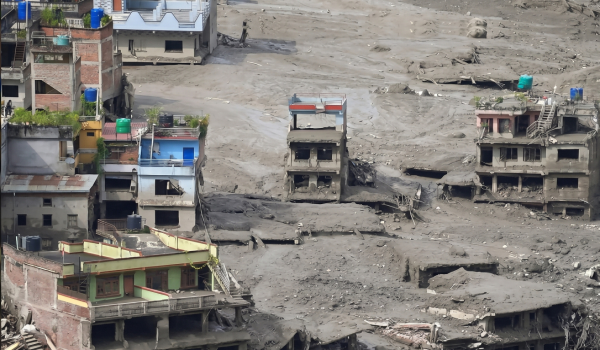

Nepal Flood Disaster Prompts Questions Over China’s Early Warning System
A devastating flash flood in Nepal’s Bhotekoshi River has triggered serious questions about disaster preparedness, cross-border information sharing, and the availability of early warning systems along the Nepal-China border.
Following the disaster, sections of the Nepali public and media questioned whether China could have provided an earlier warning about the dangerous situation developing near the border. Their argument is simple: if information about the approaching disaster had reached Nepal in time, authorities might have been able to evacuate people living in vulnerable downstream areas and reduce the loss of life.
The controversy has now drawn a response from Beijing. Chinese authorities have rejected claims that the disaster was caused by a failure or incident on the Chinese side and have called for coordination rather than blame.
According to the figures cited in the supplied report, the disaster has left 289 people dead so far, making it one of the most devastating recent natural disasters affecting the region.
Why Nepal Is Questioning China’s Warning System
The disaster struck the area around the Rasuwagadhi-Kerung border crossing and Kerung Port, affecting territory on both sides of the Nepal-China frontier.
Nepali media reports and public commentators have questioned whether China should have alerted Kathmandu as soon as dangerous conditions were detected in the border region.
The issue is particularly important because communities living downstream often have very little time to react to sudden flash floods. A warning issued even a few hours earlier can sometimes make the difference between life and death.
Nepali journalist Parshuram Kafle reportedly raised the issue on social media, arguing that Nepal has repeatedly shown concern about the safety of its neighboring countries. He questioned whether Nepal alone should bear the consequences when a disaster affects both sides of the border.
His comments display a growing concern in Nepal about whether cross-border cooperation is strong enough when natural disasters develop in remote Himalayan areas.
Questions About Glacier Lake Outburst Flood Monitoring
One of the major concerns raised after the disaster involves the monitoring of glacier-related hazards.
Former vice-chairman of Nepal’s National Planning Commission, Gobinda Raj Pokharel, said he had previously believed that effective arrangements existed for monitoring glacial lake outburst floods, commonly known as GLOFs, in the border region.
A GLOF occurs when water stored behind a glacier, ice, or natural debris is suddenly released. The resulting flood can travel rapidly through mountain valleys, carrying huge amounts of water, mud, rocks, and debris.
Such floods are particularly dangerous in the Himalayas because settlements, roads, bridges, and other infrastructure are often located close to river valleys.
Pokharel reportedly believed that China possessed sophisticated satellite technology and monitoring systems able of locating potential natural hazards along the Nepal-China border. However, the latest disaster has raised doubts about whether such systems were available, sufficiently effective, or capable of providing Nepal with timely information.
Why Flash Floods Are Difficult to Predict
One of the biggest challenges in Himalayan disasters is that dangerous floods do not always follow conventional rainfall patterns.
According to the report, there was no exceptionally heavy rainfall in the immediate area before the disaster. That made it difficult for people downstream to understand that a massive flood could suddenly arrive.
A flash flood can develop far upstream, sometimes due to a landslide, glacier collapse, the sudden release of stored water, or a combination of geological and hydrological events.
By the time the water reaches a downstream community, the people living there may have only minutes to respond.
This is why modern disaster management increasingly depends on remote sensing, satellite monitoring, river gauges, weather data, and rapid communication networks.
China Rejects the Allegations
Following criticism in Nepali media and on social media, the Chinese Embassy in Nepal responded to the allegations.
According to the statement cited in the report, China rejected claims that the destruction in Nepal was caused by a dam-related disaster on the Chinese side.
Chinese authorities said that an earthquake-like geological event or a glacier-related landslide occurred on the Nepali side on August 26. They further stated that mudslides and debris affected the Rasuwagadhi-Kerung border region, with people reported missing in both Nepal and China.
Beijing also urged both countries to focus on cooperation.
The message from the Chinese side was that apportioning blame would not help rescue efforts and that cooperation between the two countries could help save lives.
US Geological Survey Offers a Different Explanation
The cause of the disaster has also attracted attention from the United States Geological Survey, or USGS.
According to the report, the USGS indicated that the event was not an earthquake but rather associated with a massive landslide or glacier-related collapse.
Initial geological movements had reportedly been interpreted as a possible earthquake. A later assessment suggested that the movement was linked to a landslide involving glacial material and mud.
As the mass of ice, soil, and debris moved toward the river basin, it generated a powerful flood of water and debris in the Bhotekoshi River.
This explanation is significant because it changes the nature of the warning challenge. An earthquake and a glacier or landslide-triggered flood require different monitoring systems and different emergency responses.
Climate Change Could Increase Himalayan Risks
The disaster has renewed attention on the growing threat posed by climate change in the Himalayan region.
Rising temperatures are affecting glaciers and mountain environments across the Himalayas. Changes in snow and ice conditions can increase instability and create new risks around glacial lakes and steep mountain slopes.
Scientists and disaster experts have repeatedly warned that Himalayan communities need stronger monitoring systems as climate conditions change.
For Nepal and China, this means that cross-border disaster management may become increasingly important. A flood, landslide, or glacier collapse does not stop at an international boundary. Rivers cross borders, and hazards originating in one country can quickly affect communities in another.
Nepal-China Cooperation Could Become More Important
The latest controversy exposes a broader issue past the immediate disaster: how neighboring countries should share information about natural hazards.
Nepal and China share a difficult Himalayan frontier where mountains, glaciers, rivers, and extreme weather create special challenges.
An effective early warning network could include satellite observations, weather monitoring, river-level sensors, geological surveillance, and immediate communication between authorities.
If a dangerous event is detected on one side of the border, the information needs to reach officials on the other side quickly. Delays can be critical when communities are located downstream.
The Nepal disaster, therefore, raises an important question about whether existing cross-border mechanisms are sufficient to address quickly developing Himalayan emergencies.
A Warning for the Future
The tragedy in the Bhotekoshi River region demonstrates how quickly a natural disaster can turn into a humanitarian crisis.
Whether the disaster was caused by a glacier collapse, landslide, or another geological process, the central lesson remains the same: early detection and fast communication are essential in high-risk mountain regions.
Nepal’s concerns about whether sufficient warning was available are likely to fuel further discussion about disaster preparedness and cross-border cooperation.
At the same time, China’s response shows that Beijing does not accept the allegation that it failed to warn Nepal or that a Chinese dam caused the destruction.
As inquiries continue, authorities on both sides will need to establish exactly what happened, when the warning signs first appeared, and whether any available information could have been shared sooner.
For communities living in the Himalayan valleys, those answers are more than a political debate. They could determine how many lives can be protected when the next major disaster strikes.